


The Harbinger of Verity in a Disinformation-ridden Society: Our Valiant Media during Martial Law
- MAURICE ANGELI SOLEMNE
- Nov 11, 2023
- 4 min read

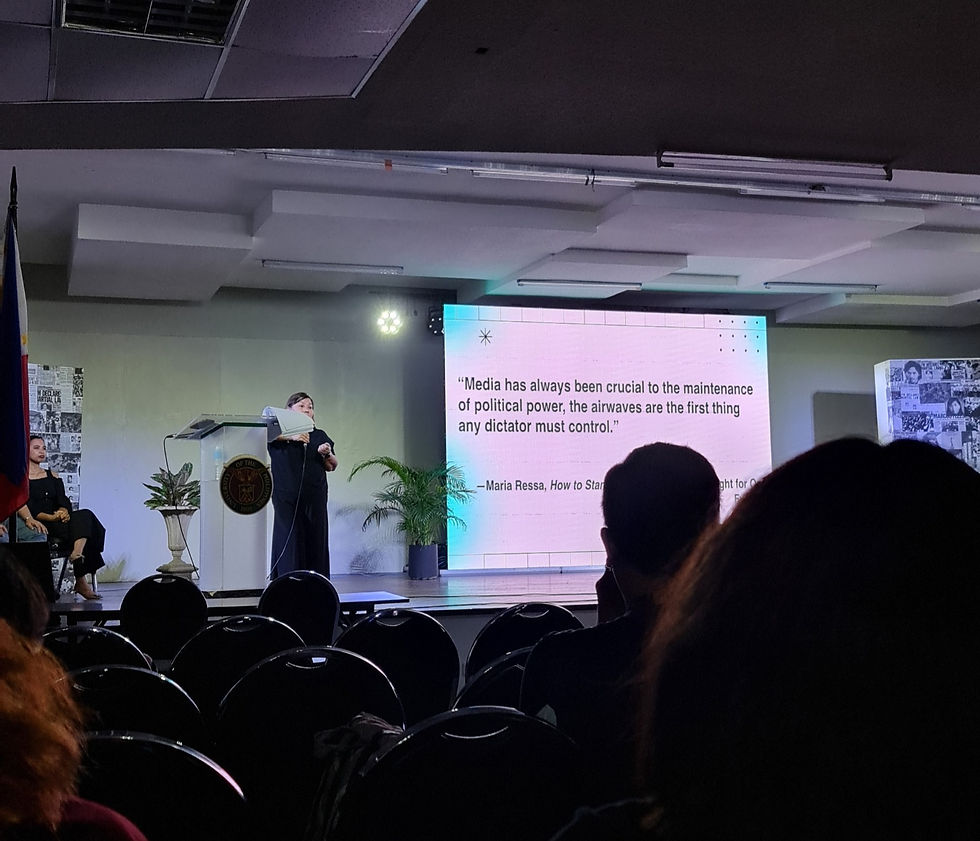
"The pen is mightier than the sword." The following quote has endured the test of time and is unaffected by any entity that attempts to undermine journalistic freedom in any nation. It even recalls the predicament the media experienced when martial law was in effect, wherein as reported by Atty. Paredes, the press was held at gunpoint. Unquestionably, the media always suffers the most casualties during political unrest. This then serves as evidence of the critical role they play in the country, illuminating the crimes committed by the public-accountable government and using every available resource to maintain transparency as the beacon of truth in a society rife with misinformation. Throughout my eight years as a campus journalist, I often wondered if I would have the courage to bravely oppose the oppression and silencing that the media endures today. Considering the persecution that the media suffered in the past, this oppression may be gradually resurfacing in our society now that the dictator's son is in positions of power. By bringing their accounts to light, we must remember them and fight against all forms of historical revisionism.
During martial regime, Ferdinand Marcos Sr., the country's tenth president and military ruler for ten of those years, identified journalists as members of the leftist movement. This is demonstrated by the way several media organizations, including ABS-CBN and the Manila Chronicles, were seized and their proprietors put in jail when the Marcos dictatorship came into being. Since they provided crucial information on politics and the nation's socioeconomic circumstances during such a dire time, journalists were not immune to the ferment. Their objective was to create a well-informed public opinion so that, despite the Marcoses' censorship and propaganda, the populace would not be uninformed of the terrible circumstances and brutal reality facing the nation. They also served as a spark for the politicization of youth, arguing that political awareness and activism were necessary to address the issues the nation was experiencing. It dawned on me then that the media had went above and beyond their duty in attempting to encourage the public to fight in order to uphold their rights, with enlightened minds and fierce determination. However, the Marcos administration thought that the public's increased consciousness gave them the impetus to suppress journalists and start attacking press freedom.
It is far from being unbeknownst and unfamiliar to us, since it occurred precisely three years prior during the lockdown that resulted in the closure of ABS-CBN. The takeover and closure of free media occurred 51 years ago, restricting journalists' freedom of speech when media outlets were taken over. Newspapers were also linked to attempts for a governmental coup by the cunning administration. 10,000 jobs were thus lost as a result of this media shutdown. I could never have imagined myself as a member of the media losing my job unfairly because of the dictatorship. Additionally, because the Writ of Habeas Corpus was suspended, media owners and journalists were arrested without following the proper legal procedures. The unarmed civilian journalists were taken into custody by troops dressed in full combat gear. Many journalists were harassed at this time; thus, it seemed as though they were seen as serious threats to the regime. Undoubtedly, a free press is essential to a functioning democracy since it serves as a source of information for the public and a watchdog on the government. Knowing this all along, Marcos Sr. took away their ability to enlighten.
There was also blanket censorship and regulation, with the Department of Public Information setting the guidelines for news reporting by the media. They were instructed to report with "Positive national value," and prior to airing or printing, approval was required. Their lips seemed to be taped shut to stifle criticism and dissent as they were prevented from releasing critical views on the armed forces. Because only media companies controlled by Marcos' allies were permitted to function, the mass media became a propaganda weapon for him. The mosquito press therefore became the alternative media amid this suppression. Journalists were able to inform the public about the atrocities committed by the government, even in a dictatorship. The Marcoses were frantic for control of this nation, but it was nothing compared to the media's unwavering will to hold the line and defend their rights.
It can be observed how the control of the media under martial law exemplifies how media models affect people's lives and political awareness in the real world. Politics and the media both have an impact on one another; politics uses the media to communicate and control its image, while the media shapes public opinion. As posited by Siebert et al., (1963), in the authoritarian model of media system, the state uses direct governmental control over the media to further its interests. Anything that may be seen as undermining the status quo or offending the political ideals that are in place is prohibited from publication or broadcast by the media. Censorship and punishment for those who violate rules are ways of control. All of these elements were exhibited during the Martial law regime, where the authoritarian model called for a press completely subservient to the state (Oates, 2008).
The women journalists in Cebu have experienced extreme harassment because of their critical articles on Marcos, even though the island of Cebu is thousands of kilometers away from the primary battlefield in Manila. They were even red tagged for reporting on the National Democratic Front's (NDF) numerous news conferences, protests, and abuses of human rights. Someone was even questioned, "Don't you know that your writings are only a hairline away from being subversive?" Even their earnings were being withheld as the tyranny grew more intense. Throughout the terrible history of martial law, the bravery of these female journalists stood out despite their marginalization from society. To hear these first-hand stories from Atty. Paredes roused the woman journalist in me to exhaust all means to ensure that their stories would not be lost in the well-oiled, well-paid misinformation machine that is busy rewriting our history.
References:
Oates, S. (2008) Introduction. In: Introduction to Media and Politics. SAGE.
Siebert, F.S., Peterson, T. and Schramm, W. (1963) Four Theories of the Press. Urbana, IL: University of Illinois Press.



Comments