


Enough with Gender-blind Political Theories!: Unlocking Dynamics between Gender and State
- MAURICE ANGELI SOLEMNE
- Dec 18, 2023
- 4 min read

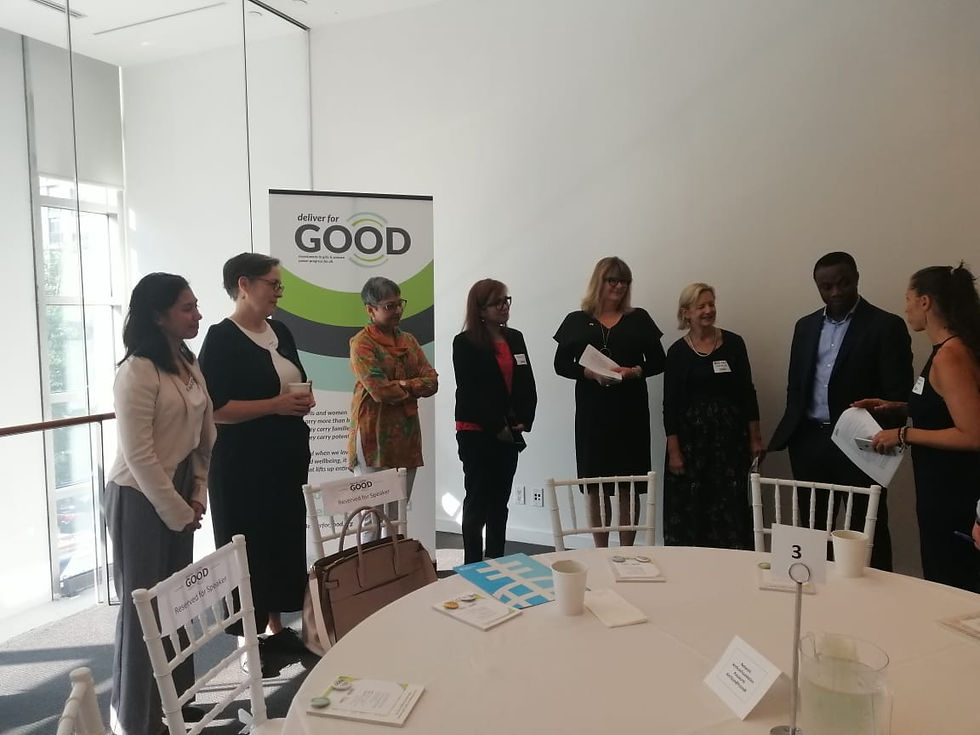
In July 2019, I was given an opportunity to speak on a Women Deliver panel discussion during the 2019 High-level Political Forum (HLPF 2019), which addressed the theme, 'Empowering people and ensuring inclusiveness and equality.' Even though the Sustainable Development Goal (SDG) 5 – achieving gender equality and empowering all women and girls – was not under review, it was critical for us to highlight the central role girls and women, and gender equality more broadly, play in advancing all 17 SDGs. We posit that we must put girls and women at the center of development to achieve the 2030 Agenda. When I was asked about some approaches leaders and partners can adopt to ensure that no one—especially marginalized girls and women—is left behind, I challenged them to mobilize us women to create solutions with our leaders and partners. It is imperative for them to include us in crafting solutions because we are the most affected by their decisions and inaction, and it is said that when diverse voices are represented like those of the marginalized, political decisions are fairer for all. We need our leaders to include us not as a hindrance but as valuable partners every step of the way. To harness the in-depth significance of these calls and demands I made in a political forum, let us first disentangle the dynamics between gender and state.
In contemporary state structures, it is common for the centers of state authority, including the spheres of military and economic decision-making, to exhibit a pronounced emphasis on masculinity. Women's near-complete absence from traditional politics is evident in their marginalization from decision-making processes and the prevailing assumption that women's daily lives are neither influenced nor deemed significant in political realms, such as those encompassed by international relations. While women are not explicitly excluded from participating in state affairs, their concerns are often channeled through less central governmental entities. According to Veneracion-Rallonza (2008), while the political arena was ostensibly made more inclusive for various marginalized segments in Philippine society, women and feminist groups were compelled to partake in deliberative dialogue, contemplating whether 'women' should be delineated as a distinct sector or regarded as an integral component across all major sectors. Women constitute a politically underrepresented group in Congress, lacking a substantive presence and influence in the political sphere.
By virtue of its role within gender dynamics and its internal structure governing gender, the state possesses the capability to oversee and regulate gender dynamics, driven by inherent incentives to undertake such regulatory measures. The government establishes institutions and formulates policies addressing gender-related matters, actively intervening to govern gender dynamics across society. A government agency in the Philippines for the advancement of women was established in January 1975 as the National Commission on the Role of Filipino Women (NCRFW), which is mandated to ensure the full integration of women for national development and further equality between women and men. In August 2009, the NCRFW) was renamed to become the Philippine Commission on Women (PCW) with the enactment of Republic Act 9710, commonly referred to as the Magna Carta of Women. The Commission serves as the principal policymaking and coordinating entity addressing issues related to women and gender equality (PCW, 2022). The government was also tasked with institutionalizing Gender and Development (GAD) programs. As noted by (Franzway et al., 1989), this is not just a marginal facet within the operations of the state, as it encompasses various policy domains, ranging from housing and education to criminal justice and the military.
Despite these developments, gender-ignorant political theories, which are characterized by frameworks that overlook or neglect gender dynamics in analyzing or explaining power structures, governance, and societal structures, persist in politics. Traditional viewpoints have an exclusionary focus on domains classified as 'high' politics, including state affairs, sovereignty, and military security, thereby neglecting the prevailing reality that men primarily occupy leadership roles within state institutions. If women exist beyond these realms of power, their experiences and contributions are deemed inconsequential. Traditional perspectives in politics and international relations consistently rationalize this exclusion. The delineation of specific domains as either excluded or included is rooted in gendered notions of what counts and does not.
Moreover, gendered identities are socially constructed, reinforcing normative expectations regarding the roles and behaviors deemed appropriate for men and women. Patriarchal power permeates these gender identities, subordinating women's identities to those of males. Consequently, it dictates the allocation of power, influencing where women are in the realm of politics. A case in point would be how military activities and engagement in warfare are perceived as traditionally masculine pursuits aimed at safeguarding women and children. This perception has resulted in the marginalization of the diverse ways women contribute to and experience conflicts. There is a grave issue related to sexual and gender-based violence during conflict, where instances of mass rape during World War II were not prosecuted, as they were regarded merely as an unfortunate by-product of warfare. This is a testament to how women's experiences and perspectives on politics are more easily ignored and justified as marginal. Violence against women, to which we are routinely exposed, must not be tacitly accepted as a normal state of affairs.
As Nash and Scott (2001) asserted, theoretically, state perspectives disregarding gender are intellectually obsolete. Politically, they can be seen as contributing to the defense of patriarchy, actively obscuring the gender impacts inherent in the institutions they claim to analyze. This necessitates the deconstruction of gender, which questions preconceived notions regarding the prescribed roles based on gender, influences the scope of actions permissible in politics, and redefines what is deemed essential in the field of international relations. Intersectionality must also be taken into account, where the dynamics of politics are shaped not solely by gender but also by intersecting identities, including race, class, and ethnicity. Examining these intersections is crucial in understanding how various groups are marginalized; thus, it is imperative to consider these identities collectively rather than in isolation. Let us persist in challenging the perception that the entire sphere of the 'political' is conventionally regarded as a realm exclusive to men, both in theory and praxis.
References:
Franzway, S., Court, D., and Valen, H. (1992). Electoral Change: Responses to Evolving Social and Attitudinal Structures in Western Countries. Cambridge: CUP.
Nash, K., & Scott, A. (Eds.). (2008). The Blackwell companion to political sociology. John Wiley & Sons.
Philippine Commission on Women. (2022, September 15). Herstory. https://pcw.gov.ph/herstory/
Veneracion-Rallonza, M. L. (2008). Women and the Democracy Project: A Feminist Take on Women's Political Participation in the Philippines. Archium Ateneo. https://archium.ateneo.edu/cgi/viewcontent.cgi?article=1048&context=polsci-faculty-pubs


Comments